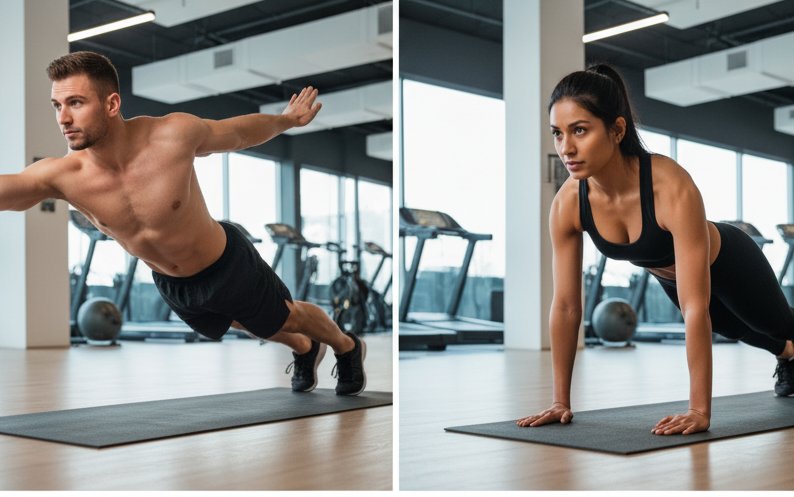
Sculpt your entire core with plank variations, form tips, progressive overload, and recovery strategies for stronger abs and better performance
Table of Contents
Plank Variations That Sculpt the Entire Core
Planks are the unsung heroes of core training — simple, scalable, and brutally effective when done right. Whether you’re training for strength, better posture, or athletic performance, the right plank variations will target every layer of your core: rectus abdominis, obliques, transverse abdominis, and even the lower back and glutes. In this guide, I’ll walk you through setup cues, practical progressions, gym-tool options, and recovery tips so you can build a resilient midsection without boring, repetitive crunches.
Why Planks Work: Strength Training for the Core
Planks are isometric strength training moves — they build tension and stability rather than just moving through a range of motion. That makes them exceptional for muscle growth in stabilizers and improving transfer to compound lifts and daily activities.
Use progressive overload by increasing hold time, adding resistance, or introducing instability. Pair that with balanced workout routines and proper recovery for sustainable results.
Form Checklist
- Neutral spine: avoid sagging hips or an overly arched back.
- Engage the core: draw the belly button toward the spine without holding your breath.
- Shoulder position: press actively through your shoulders to avoid shrugging.
- Neck alignment: keep your gaze a few inches in front of your hands to protect the cervical spine.
- Breathe steadily: equal inhales and exhales to maintain tension and control.
Top Plank Variations to Target the Entire Core
Below are plank variations that progressively challenge strength, stability, and coordination. Use tools like a stability ball, TRX, sliders, or a weighted plate to advance your training.
- Forearm Plank — The standard baseline. Keep elbows under shoulders, core braced, and hips level. Great for building endurance and teaching neutral spine.
- High Plank — Hands under shoulders; mimics push-up position and integrates chest and shoulder stability.
- Side Plank — Targets the obliques and improves lateral stability. Modify by dropping the bottom knee for an easier variation.
- Plank with Shoulder Taps — Alternate hand taps to build anti-rotation strength and shoulder stability. Keep hips square to the ground.
- Plank to Push-Up (Up-Down Plank) — Dynamic transition that adds upper body strength while demanding core control.
- RKC Plank — Intensely braced forearm plank where you actively pull elbows toward feet and toes toward elbows for maximal tension.
- Stability Ball Plank — Place forearms on a ball to introduce instability and challenge deep core muscles.
- TRX Plank — Feet in TRX straps increase instability and force the core and posterior chain to work harder.
- Plank Jacks — Add cardio and dynamic hip abduction while maintaining core tension.
- Reverse Plank — A posterior-chain focused hold that balances the anterior work and improves glute and hamstring activation.
Sample Core Workout: Build Strength & Endurance
Try this 20–25 minute routine 2–3 times per week as part of your workout program. Combine with your regular leg day routine or upper-body sessions for balanced development.
- Warm-up: 5 minutes dynamic movement (cat-cow, hip circles, shoulder rolls).
- Forearm Plank — 3 sets x 30–60 seconds (rest 45 seconds)
- Side Plank — 3 sets x 20–40 seconds per side
- Plank with Shoulder Taps — 3 sets x 12–16 taps (each shoulder)
- Stability Ball Plank — 2 sets x 30 seconds for added instability
- Cool-down: 5 minutes stretching, including child’s pose and thoracic rotations.
Progress using progressive overload: increase hold time by 5–10 seconds, add a light weighted vest or plate, or introduce a harder variation every 1–2 weeks.
Tool-Based Solutions for Faster Progress
Gym tools accelerate progress and add variety. Use a stability ball to recruit deep stabilizers, sliders for anti-extension work, TRX for unilateral challenges, and resistance bands for added tension. An ab wheel is excellent for teaching anti-extension strength when used after mastering basic planks.
For tracking progress and aligning nutrition to your training, try the TotalHealthTools calculators to dial in recovery and energy needs.
Read also: “Calorie & Macro Calculator”
Recovery Tips to Keep Growing Stronger
Recovery is where the gains happen. Treat core training like any strength session: track volume, avoid daily maximal holds, and prioritize sleep and hydration.
- Active recovery: light mobility and walking on off-days supports circulation and recovery.
- Sleep: aim for consistent sleep to support muscle repair and nervous system recovery.
- Hydration & protein: support muscle function and repair with balanced hydration and adequate protein intake.
- Mobility & foam rolling: maintain thoracic mobility and hip flexor length to prevent compensations during planks.
Read also: “Hydration Calculator”
Common Mistakes and How to Fix Them
- Hips too high: Lower hips slightly and re-engage glutes to maintain a straight line.
- Shoulder shrugging: Press through the shoulders and pull the scapulae down to stabilize.
- Holding your breath: Practice rhythmic breathing — inhale for 3, exhale for 3 while maintaining tension.
- Overtraining: Rotate plank intensity and include rest days — quality beats quantity.
Conclusion
Planks are a versatile, time-efficient way to sculpt the entire core when you focus on form, progression, and recovery. Mix variations, use tools like stability balls or TRX to challenge yourself, and track progress with smart overload strategies. Start with solid technique, add small challenges each week, and your core will become stronger, more resilient, and better integrated into your full-body workouts.