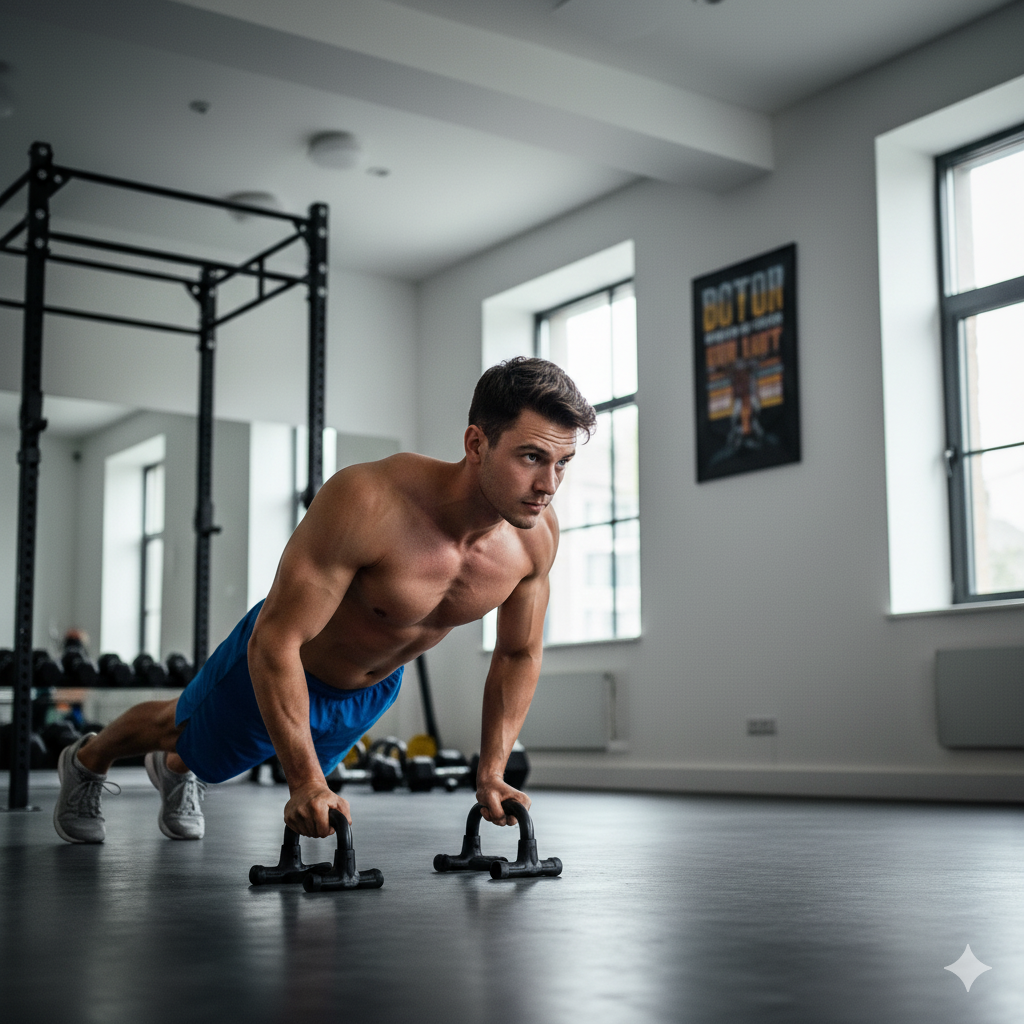
Level up your chest with beginner-friendly bodyweight chest exercises, progressions, and recovery tips for strength training and muscle growth.
Ready to build a stronger chest without a gym membership or heavy equipment? This guide walks beginners through simple, effective bodyweight chest exercises that improve strength, posture, and muscle growth. You’ll learn progressions, proper form cues, and recovery tips so you can follow a safe, motivating workout routine at home. Whether you’ve never done a push-up or want to move beyond the basics, these clear steps help you get results using only your body and common household surfaces.
Why Bodyweight Chest Exercises Work
Bodyweight training teaches movement quality, control, and joint stability while building functional strength. For beginners, push-up variations and pressing patterns offer a gentle learning curve and clear ways to apply progressive overload — the core idea behind muscle growth and strength training.
These workouts also fit into busy schedules and require minimal space or “gym tools” like a sturdy chair, stairs, or a low table for incline work.
Essential Chest Exercises for Beginners
Start with these foundational movements. Aim for controlled reps and clean technique rather than chasing high numbers.
- Wall Push-ups — Foot distance from the wall controls difficulty. Great for absolute beginners to learn pressing mechanics.
- Incline Push-ups — Hands on a bench, chair, or countertop. Less load than floor push-ups and helpful for shoulder comfort.
- Knee Push-ups — A transitional option from incline to full push-ups while keeping a neutral spine.
- Standard Push-ups — Chest-focused when hands are slightly wider than shoulder-width and elbows tracked at 45 degrees.
- Decline Push-ups — Feet elevated to increase difficulty and emphasize upper chest and shoulders.
- Diamond Push-ups — Hands close together to target triceps and inner chest; use sparingly until strength improves.
- Isometric Holds (Plank to Push-up) — Build stability and time-under-tension for stronger pressing mechanics.
How to Perform a Safe Push-up (Form Cues)
Quality beats quantity. Use these cues on every rep:
- Keep a straight line from head to heels — avoid sagging or hiking hips.
- Engage your core and glutes for stability.
- Lower with control until your chest approaches the floor (or the chosen surface) and press back up explosively but controlled.
- Breathe in on the descent, exhale during the push.
- Keep elbows at about a 30–45° angle from the body to protect shoulders and load the chest.
Beginner Chest Workout Routine (Bodyweight)
Follow this simple, 3-day weekly plan for 6–8 weeks. Rest at least 48 hours between chest-focused sessions to let muscles recover and adapt.
- Day A
- Wall Push-ups: 3 sets of 12–15
- Incline Push-ups: 3 sets of 8–12
- Isometric Hold (30–45 sec): 2 sets
- Day B
- Knee Push-ups: 3 sets of 8–12
- Standard Push-ups: 3 sets of 6–10 (or as many quality reps as possible)
- Plank to Push-up: 3 sets of 6–8 transitions
- Day C (Progression Day)
- Incline Push-ups (narrow or standard): 3 sets of 10–15
- Negative/Slow Descent Push-ups: 3 sets of 5–8 (3–4 second lower)
- Decline or Diamond Push-ups (optional): 2 sets of 4–8
Progressive Overload — Get Stronger Over Time
Progress by adding reps, sets, slowing the tempo, or moving to a harder variation. Track your workouts in a notebook or app and aim for small weekly improvements. This steady increase is how muscle growth and strength training results happen without weights.
Recovery Tips and Muscle Growth Basics
Recovery is where the benefits of your hard work show up. Follow these practical tips:
- Prioritize 7–9 hours of sleep and steady hydration for performance and recovery.
- Eat enough protein and calories to support repair — use the “Calorie & Macro Calculator” to plan intake.
- Schedule rest days and include light mobility work or walks to aid circulation and reduce soreness.
- Gradually increase training volume to avoid overuse injuries.
Common Beginner Mistakes and How to Fix Them
Keep these corrections in mind so you progress safely:
- Too fast, too soon: Focus on form. Slow, controlled reps build strength faster than sloppy volume.
- Neglecting scapular control: Start each set with a shoulder blade squeeze and maintain scapular stability throughout.
- Not varying the angle: Use incline and decline variations to hit different chest fibers without added weight.
- Ignoring recovery: More workouts aren’t always better; recovery fuels muscle growth and prevents burnout.
Tool-Based Solutions That Stay Bodyweight-Centric
You don’t need free weights to progress — use household surfaces and simple tools to change leverage and difficulty:
- Sturdy chair or bench for incline/decline push-ups.
- Towel on a smooth floor to practice sliding chest flies (advanced bodyweight variant).
- Steps or stairs for elevated hand positions or single-leg stability drills.
These “gym tools” let you scale intensity while keeping training bodyweight-only and flexible for home use.
Conclusion
Beginner chest development with bodyweight exercises is simple, effective, and adaptable. Start with solid form, follow the progression examples, and use small weekly increases to build strength and muscle. Track your nutrition with tools like the Calorie & Macro Calculator and stay consistent — that’s how you’ll see real progress. Get started today and celebrate steady wins along the way.