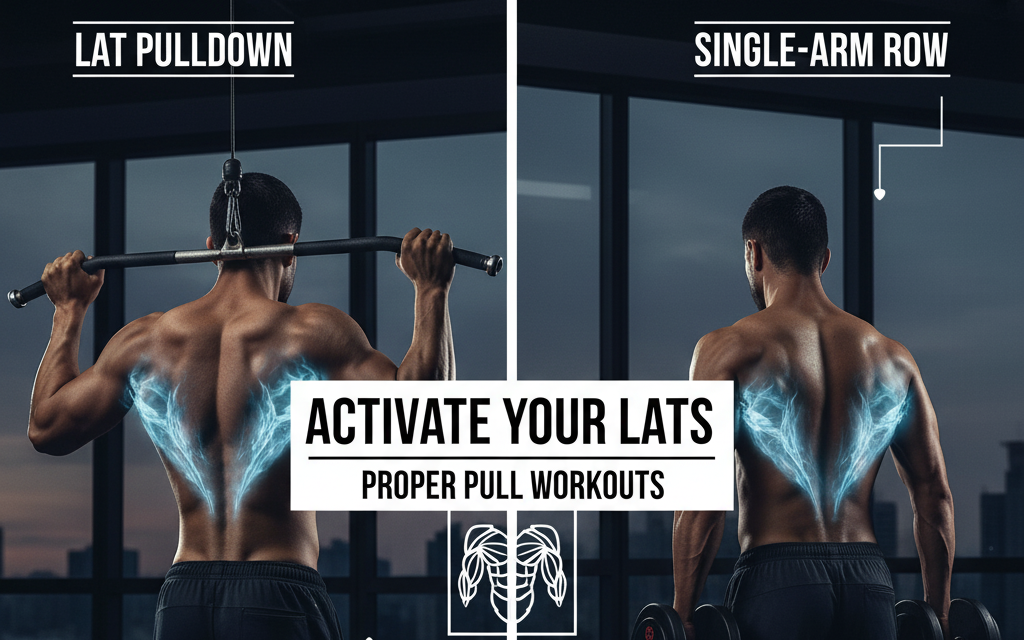
Learn practical tips and drills to activate your lats properly during pull workouts for better strength, muscle growth, and posture.
Table of Contents
Activate Lats Properly for Pull Workouts
Want stronger pull days and a wider, more powerful back? Proper lat activation is the foundation of every effective pull workout. If your lats aren’t firing, other muscles compensate, progress stalls, and form breaks down. This guide breaks down simple, coach-tested cues, warm-up drills, and exercise progressions so you feel your lats working on every rep. No complicated jargon — just clear steps and tool-based tips to level up your strength training and muscle growth.
Why Lat Activation Matters for Strength Training
Your latissimus dorsi connects your upper arm to your torso and drives pulling motions. When the lats engage correctly, you get more power in rows and pull-ups and protect your shoulders during heavy lifts.
Better lat activation improves posture, supports progressive overload, and enhances transfer to other lifts like deadlifts and bent-over rows. Think of lat activation as the starting signal for efficient pull workouts and sustainable muscle growth.
How Lats Affect Other Muscle Groups (bicep workouts, chest exercises)
When lats do their job, biceps and rear delts can play supportive roles instead of doing the heavy lifting. That means cleaner reps, better mind-muscle connection, and faster gains. Even chest exercises benefit from balanced posture created by a strong back.
Warm-Up and Mind-Muscle Connection
Begin every session with intentional warm-ups to “wake up” your lats. A five- to ten-minute routine primes the muscles and reinforces the neural pathways that help you feel them.
- Arm circles and band pull-aparts — 2 sets of 12–15 reps
- Scapular pull-ups or dead hangs — 3 sets of 5–8 reps (focus on shoulder blades)
- Single-arm band lat pulls — 2 sets of 12 each side, slow and controlled
Use light resistance and slow tempo. The goal is sensation, not fatigue. Concentrate on pulling your elbow down and back rather than thinking about your hands.
Key Cues to Activate Lats During Pull Exercises
Cues help translate intention into movement. Repeat short, simple cues during each rep to keep the lats engaged:
- Elbow drive: Pull with your elbows, not your hands.
- Rib-to-hip: Imagine your ribs sliding toward your hips to shorten the lat.
- Pack the shoulders: Slightly retract and depress the shoulder blades before pulling.
- Slow the first half: Initiate each rep slowly to feel the lats engage, then finish smoothly.
Practical Drills to Reinforce the Cue
Drills transfer the feeling into compound lifts:
- Chest-supported rows with light weight — 3 sets of 10
- Single-arm dumbbell rows with a paused contraction — 3 sets of 8–10 per side
- Band-assisted pull-ups focusing on scapular depression — 3 sets of 6–8
These movements reduce cheat factors like excessive torso rotation and help you groove the correct movement pattern.
Exercise Selection and Progressions for Pull Workouts
Choose exercises that promote lat lengthening and a full range of motion. Progress from isolated drills to compound lifts as your lat awareness improves.
- Beginner: Single-arm band lat pulls, scapular pull-ups, chest-supported rows
- Intermediate: One-arm dumbbell rows, machine rows, lat pulldowns with a full stretch
- Advanced: Weighted pull-ups, barbell bent-over rows, chest-to-bar pull-ups
Program progressive overload by increasing reps, weight, or improving control rather than chasing heavier loads and bad form. Track your workouts in a simple log to measure small wins each week.
Form Tips and Common Mistakes
Keep these form points in mind to avoid letting other muscles steal the work:
- Avoid shrugging — maintain scapular depression through the movement.
- Limit bicep dominance — pause at the top and squeeze the lats before lowering.
- Don’t over-rotate the torso — keep a neutral spine and hinge from the hips when needed.
- Start light — heavy weight often feels impressive but can mask poor activation.
Using Gym Tools to Improve Lat Engagement
Resistance bands, cables, and benches are simple tools that provide feedback and control. A band teaches tension at the end range; a cable provides consistent resistance through the movement; a chest-supported bench removes momentum.
- Use a band for pre-activation and burnout sets.
- Cable rows allow you to focus on elbow path and lat contraction.
- Chest-supported variations prevent spinal compensation and improve feeling.
Recovery Tips and Consistency for Muscle Growth
Lat activation improves quickly with consistent practice, but recovery matters. Progressive strength gains happen when you balance effort with recovery tips like adequate sleep, nutrition, and regular mobility work.
- Schedule at least 48 hours between intense heavy back sessions.
- Include mobility and thoracic extension drills 2–3 times per week.
- Use foam rolling or light band work to relieve tight lats after sessions.
Tracking your calories and macros supports muscle repair — try our calorie and macro calculator to align nutrition with your goals.
Read also: “Calorie & Macro Calculator”
Sample Pull Workout for Lat Activation
Start with activation and move into compound work. Repeat 2–3 times per week depending on volume and recovery.
- Warm-up: Band pull-aparts + scapular pull-ups — 3 rounds
- Activation: Single-arm band lat pulls — 2 x 12 each side
- Main: Weighted pull-ups or lat pulldowns — 4 x 6–10
- Accessory: Single-arm dumbbell rows (paused) — 3 x 8–10 each side
- Finisher: Straight-arm cable pulldown for lat stretch and burn — 3 x 12–15
Finish with mobility or light stretching for the shoulders and lats to maintain healthy range of motion.
Conclusion
Lat activation is a skill you can build. Use warm-ups, focused cues, targeted drills, and gradual progressions to ensure your lats lead every pull. Pair consistent practice with smart recovery and the right gym tools to accelerate strength training and muscle growth. Start today with one activation drill and track your progress — your next pull workout will feel noticeably stronger.