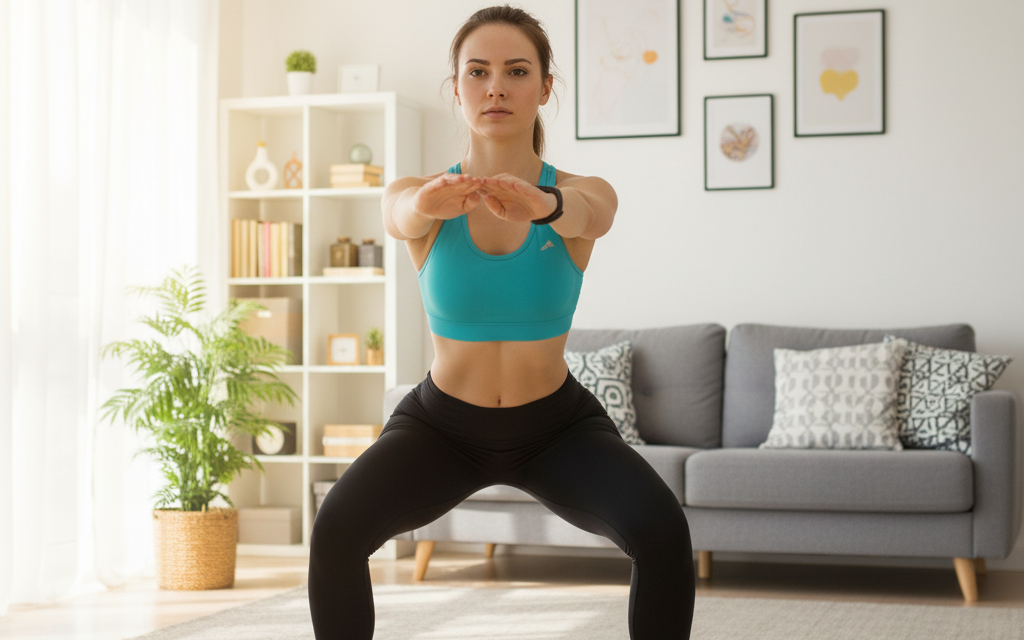
Build strong legs at home with no equipment—beginner to advanced routines, form tips, recovery advice, and progressive overload strategies.
Table of Contents
Home Leg Workouts Without Equipment
Want powerful legs without a gym membership? You’re in the right place. This guide walks you through bodyweight leg workouts from beginner to advanced, teaches smart progression methods for strength training and muscle growth, and gives practical recovery tips so you stay consistent. Whether you’re short on time or equipment, these routines and form cues will help you build a balanced leg day routine at home.
Why Bodyweight Leg Training Works
Bodyweight leg exercises develop strength, endurance, and mobility—key components of functional fitness. Training at home improves stability and coordination while reducing barriers to consistency, a major factor in long-term progress.
Use progressive overload, targeted reps, tempo control, and variation to stimulate muscle growth even without gym tools. Small, steady increases make all the difference.
Beginner Leg Workout (No Equipment)
This routine builds a base: balance, hip drive, and quad and glute engagement. Aim for 2–3 sets of each exercise, 8–15 reps depending on your fitness level. Rest 45–90 seconds between sets.
- Bodyweight Squat — Feet shoulder-width, chest up, sit back into hips. 10–15 reps.
- Reverse Lunge — Step back, keep torso upright, drive through front heel. 8–12 reps per leg.
- Glute Bridge — Squeeze glutes at the top, avoid arching the lower back. 12–20 reps.
- Standing Calf Raise — Slow up, control down, full range. 15–20 reps.
- Wall Sit — Hold 30–60 seconds for endurance and quad strength.
Focus on clean form over volume—quality reps build a stronger foundation and reduce injury risk.
Intermediate Leg Routine
Increase intensity with unilateral work and tempo changes. Aim for 3–4 sets, 6–15 reps, or 30–60 seconds holds. Add a little cardio (jump rope or quick sprints) after the session for conditioning.
- Bulgarian Split Squat — Rear foot elevated, lean slightly forward, drive through the front heel. 8–12 reps per leg.
- Walking Lunges — Long steps for glute emphasis or short steps for quads. 12–16 steps total.
- Single-Leg Romanian Deadlift (Bodyweight) — Slow hinge, maintain balance and hip stability. 8–12 reps per leg.
- Jump Squats — Soft landings, full hip extension, control the descent. 8–12 reps.
- Elevated Single-Leg Calf Raise — Use a stair edge or book to increase range. 12–20 reps per leg.
Advanced Leg Workout (No Equipment)
For advanced trainees, the priority is high-intensity, unilateral strength, and controlled eccentric work. Choose 3–5 exercises, 3–5 sets. Keep rest 60–120 seconds and prioritize maximal but safe effort.
- Pistol Squat Progressions — Box pistol, assisted pistol, then full pistol. 5–8 reps per leg.
- Shrimp Squat — Deep single-leg control, great for strength and mobility. 6–10 reps per leg.
- Nordic Hamstring Curl (Assisted) — Slow eccentric focus to build hamstring strength. 5–8 reps.
- Broad Jumps or Depth Jumps — Explosive power and coordination. 6–10 reps.
- Slow-Eccentric Split Squats — 3–4 second descent to overload without weights. 6–10 reps per leg.
Progressive Overload Without Weights
Progressive overload is possible without dumbbells. Use these strategies to keep improving:
- Increase reps or sets gradually (e.g., +1–3 reps per week).
- Slow down the eccentric phase (3–5 seconds) to increase time under tension.
- Use unilateral versions to double the load per limb (single-leg squats, Bulgarian splits).
- Add pauses at the bottom of a movement to remove momentum.
- Use plyometrics and tempo changes to challenge power and endurance.
Proper Form & Injury Prevention
Form beats ego. Keep these cues in mind to protect knees and lower back:
- Drive through the heels on squats and lunges to engage glutes.
- Keep knees tracking over toes; avoid collapsing inward.
- Maintain a neutral spine—no excessive rounding or arching.
- Breathe: inhale on the way down, exhale as you push or stand.
- Warm up 5–10 minutes with dynamic movements—leg swings, hip circles, bodyweight squats.
Recovery Tips for Better Gains
Recovery is where strength gains happen. Prioritize sleep, nutrition, and active recovery to support muscle growth and performance.
- Get consistent sleep—aim for quality rest each night.
- Stay hydrated and eat protein-rich meals to support repair.
- Use light mobility sessions, foam rolling, or stretching on rest days.
- Schedule at least one full rest day per week and listen to your body.
Read also: “Calorie & Macro Calculator”
Tool-Based Solutions to Enhance Home Workouts
While you can do a lot with bodyweight, small tools boost progression and variety. Resistance bands, a suspension trainer, or a single kettlebell/backpack can add load and challenge different planes of motion.
- Resistance bands — add tension for squats, glute bridges, and lateral work.
- Backpack with books — increase resistance for squats or lunges safely.
- Chair or step — useful for elevated split squats, box pistol progressions, and tempo variations.
Integrating simple gym tools can shorten time to strength improvements without overwhelming your routine.
Conclusion
Home leg workouts without equipment are effective at any level when you focus on form, progressive overload, and recovery. Start with the beginner plan, add unilateral work and tempo changes for the intermediate stage, and challenge yourself with advanced single-leg and eccentric techniques. Stay consistent, track progress with tools like a calorie or sleep calculator, and celebrate small wins—strong legs are built one rep at a time.