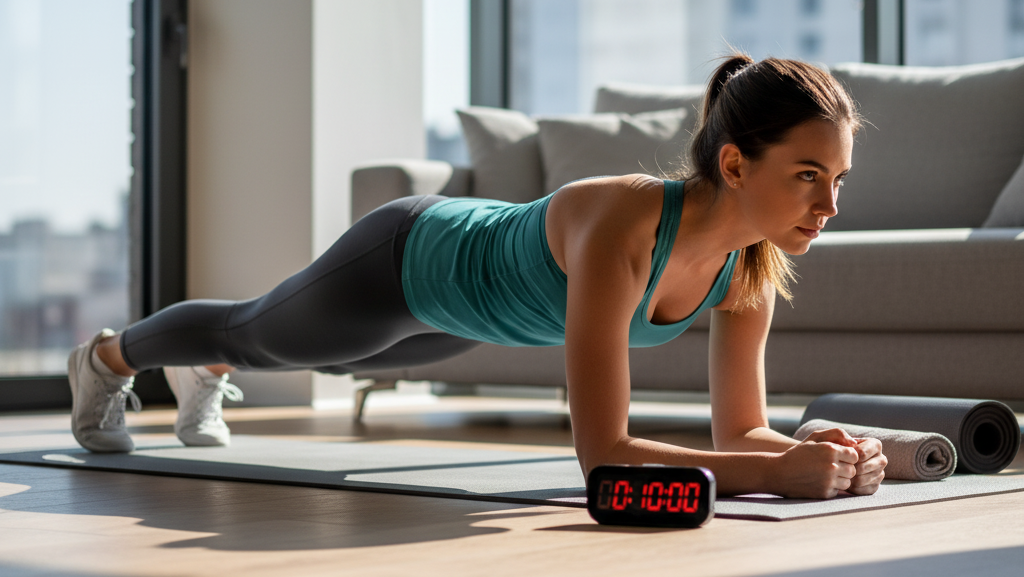
Build strength and muscle with the best home workouts that require no equipment—easy routines, form tips, progressive overload, and recovery strategies.
Table of Contents
Best Home Workouts — No Equipment Needed
You don’t need a gym membership or fancy machines to build strength and feel fitter. With the right bodyweight exercises, smart programming, and consistent effort, you can create effective workout routines that support muscle growth, improve endurance, and boost confidence—right in your living room. This guide breaks down practical, no-equipment workouts, form cues, progression strategies, and recovery tips so you can train safely and see steady results.
Why Bodyweight Workouts Work for Strength Training
Bodyweight training uses your own mass to challenge muscles, teach movement patterns, and develop functional strength. When programmed well, bodyweight workouts improve muscle growth, mobility, and cardiovascular fitness without gym tools.
Key benefits include accessibility, low cost, and variety—everything from core-focused sessions to tough full-body circuits. The trick is to manage intensity and progressive overload so your workouts keep producing gains.
Principles: Progressive Overload, Proper Form, Recovery Tips
Progressive overload doesn’t require weights. You can increase reps, reduce rest, change leverage, or add tempo to make exercises harder. Always prioritize proper form over quantity to avoid injury and ensure muscles are targeted effectively.
- Progressive overload: Increase difficulty gradually—more reps, slower tempo, single-leg/single-arm variations.
- Form cues: Keep a neutral spine, engage the core, control the tempo, and breathe rhythmically through each rep.
- Recovery tips: Sleep, nutrition, hydration, and light mobility work between sessions help muscles rebuild and perform better.
Full-Body No-Equipment Workout Routine
Try this balanced routine 3–4 times per week. Warm up for 5–10 minutes (dynamic movements and joint mobility) before starting and cool down with light stretching after.
- Push-ups — 3 sets of 8–15 reps. Keep hands under shoulders, lower chest to the floor, drive through palms to full extension.
- Squats — 3 sets of 12–20 reps. Push hips back, weight through heels, knees tracking toes.
- Reverse lunges — 3 sets of 8–12 reps per leg. Step back, keep torso upright, drive through front heel.
- Glute bridges — 3 sets of 15–20 reps. Squeeze glutes at the top and control the descent.
- Plank — 3 sets of 30–60 seconds. Maintain a straight line from head to heels, avoid sagging hips.
- Inverted row alternative — 3 sets of 8–12 reps. Use a sturdy table edge (careful) or perform “lying T” pulls to emphasize the upper back.
Adjust sets and reps based on fitness level. If a movement becomes easy, progress by adding tempo (e.g., 3-second negatives), switching to single-leg/single-arm versions, or minimizing rest between sets.
Bicep Workouts and Chest Exercises Without Weights
Targeting the biceps without a pull-up bar or dumbbells requires creativity. Isometric holds and slow eccentric actions increase time under tension, which helps muscle growth.
- Close-grip push-ups — Emphasize the chest and triceps; hands close together to shift load.
- Chin-up alternatives — If you have a sturdy door frame or table row setup, perform controlled pulls. If not, do towel curls by looping a towel under a heavy, stable object and pulling (ensure safety).
- Negative-focused reps — For any pulling motion you can perform, emphasize the lowering phase for 3–5 seconds to increase stimulus.
When no equipment is available, prioritize compound movements that recruit multiple muscle groups. This yields better strength and muscle adaptations than isolated moves alone. Building stronger biceps and a well-defined chest doesn’t always require dumbbells, barbells, or expensive gym equipment—in fact, you can create a highly effective upper-body routine using nothing but your bodyweight and proper training technique. When it comes to bicep workouts without weights, the key is understanding how to use leverage, angles, and controlled movement to create resistance. One of the best biceps-focused exercises is the reverse-hand push-up, where you rotate your wrists so your fingers point toward your feet, forcing your biceps to take over as you push your body upward. Another powerful movement is the towel curl, which mimics the curling motion using a stable object like a pole or doorframe—your body becomes the weight, and by adjusting your leg position, you can increase or decrease difficulty. Inverted rows under a table, using an underhand grip, also activate the biceps tremendously while improving back strength. Even simple isometric holds, such as squeezing your biceps for 20–30 seconds or performing “static curls” by pressing your palms upward against a solid object, help build muscle endurance and definition when performed consistently.
For chest workouts without weights, bodyweight training offers some of the most effective, muscle-building exercises available. Push-ups remain the king of equipment-free chest training—they target the pectorals, shoulders, and triceps while allowing endless variations for progression. Wide push-ups emphasize the chest, while diamond push-ups engage the inner chest and provide intense tricep activation. Decline push-ups, where your feet are elevated on a chair or bench, shift the resistance toward the upper chest, helping build that aesthetic upper-pec fullness. Incline push-ups, done with hands elevated, reduce difficulty but offer a great warm-up option or endurance finisher. If you want more tension, try archer push-ups or pseudo-planche push-ups, which place more load on one side or on the chest as the body leans forward. Another underrated technique is the slow-eccentric push-up, where you take 3–5 seconds to lower your chest—this increases time under tension and stimulates more muscle growth. Bodyweight chest dips on parallel surfaces like a sturdy countertop or chairs placed side-by-side are also excellent for deep chest activation.
Combining bicep workouts and chest exercises without weights allows you to train effectively anywhere—at home, outdoors, or even while traveling—making it a perfect routine for beginners and advanced athletes alike. The key to results is consistency and progression. You can increase intensity by adjusting leverage, increasing repetitions, slowing down movements, or using unilateral variations like single-arm push-up progressions or one-arm towel curls. Don’t forget to include proper warm-up drills such as arm circles, scapular push-ups, and wrist mobility movements to prevent strain and enhance performance. With the right routine, bodyweight training can help you develop impressive upper-body strength, sculpted arms, and a solid chest without ever picking up a weight. Whether your goal is muscle growth, fat loss, or overall fitness, these no-equipment exercises prove that you can transform your physique using discipline, creativity, and just your own bodyweight.
Progressive Overload at Home
Progress matters more than perfection. Track your workouts so you can increase intensity systematically. Small, consistent increases create lasting gains without overtraining.
- Increase reps by 1–2 per set.
- Reduce rest time by 10–15 seconds between sets.
- Add harder variations: single-leg squats, decline push-ups, or plyometric movements.
- Change tempo: slower eccentrics and paused reps force muscles to work harder.
Use a simple workout log or a tool to track progress. For nutrition and recovery alignment, check a macro or calorie calculator to ensure you’re supporting your goals.
Read also: “Calorie & Macro Calculator”
Recovery Tips for Better Results
Training hard is only half the battle—recovery is where adaptation happens. Plan rest days, prioritize sleep, and fuel your body with balanced meals that include protein to support muscle repair.
- Active recovery: Light walking or mobility sessions help blood flow and reduce stiffness.
- Mobility work: Hip, shoulder, and thoracic mobility improve movement quality and reduce injury risk.
- Nutrition: Aim for a balanced intake of protein, carbs, and fats to support workouts and recovery.
For quick reference tools and trackers, TotalHealthTools offers useful resources to plan nutrition and training more effectively.
Sample Weekly Split (No Equipment)
- Day 1 — Full Body Strength: Routine above focusing on controlled reps and compound moves.
- Day 2 — Active Recovery: Mobility flow, light walk, foam rolling (if available).
- Day 3 — Lower Body Focus: Add single-leg work, Bulgarian split squats (using a chair), and calf raises.
- Day 4 — Upper Body & Core: Push-up variations, bodyweight rows, planks, and hollow holds.
- Day 5 — HIIT or Cardio: Short circuits of burpees, mountain climbers, jumping squats for conditioning.
- Days 6–7 — Rest or Gentle Activity: Prioritize sleep and nutrition to recover.
Conclusion
No-equipment home workouts are powerful, flexible, and effective when you focus on form, progression, and recovery. Use compound bodyweight movements, monitor your progress, and tweak intensity with tempo or harder variations. Start with consistency—build routines, track results, and use TotalHealthTools like the calorie & macro calculator to support your goals. Lace up your shoes, clear a small space, and get moving—your future stronger self will thank you.