Try this motivating 10-minute ab challenge you can do anywhere — practical moves, form tips, recovery, and tools to boost core strength and workout consistency.
Table of Contents
Daily 10-Minute Ab Challenge You Can Do Anywhere
Short on time but want a stronger, more resilient core? This daily 10-minute ab challenge is built for busy people who want real results without a gym. With a mix of bodyweight movements and optional gym tools, the plan focuses on proper form, progressive overload, and recovery so you can improve core strength, posture, and athletic performance over time.
Why a 10-Minute Ab Challenge Works for Fitness
Ten focused minutes every day beats one long, inconsistent session. Short, consistent workouts help build habit and accumulate volume without burning you out. When you combine daily core work with balanced strength training and proper nutrition, you’re supporting muscle growth and functional strength.
Core Strength, Muscle Growth, and Stability
Your core is more than abs — it’s the hub for movement, balance, and power. A targeted routine improves stability for lifts, reduces risk of injury, and enhances posture. Use progressive overload (more reps, harder variations, or light resistance bands) to challenge muscles over time.
Daily 10-Minute Routine You Can Do Anywhere
This plan is simple, scalable, and requires minimal equipment. Do it on a carpet, yoga mat, or even in a hotel room. Aim for controlled, quality reps rather than speed. If you have gym tools like a resistance band, ab wheel, or stability ball, use them to increase challenge.
- Warm-up (60 seconds) — light marching, hip circles, and diaphragmatic breathing to prime the core.
- Round structure — 5 exercises, 40 seconds work / 20 seconds rest. Complete two rounds (total ~9 minutes) plus warm-up and cool-down.
Exercises (bodyweight base):
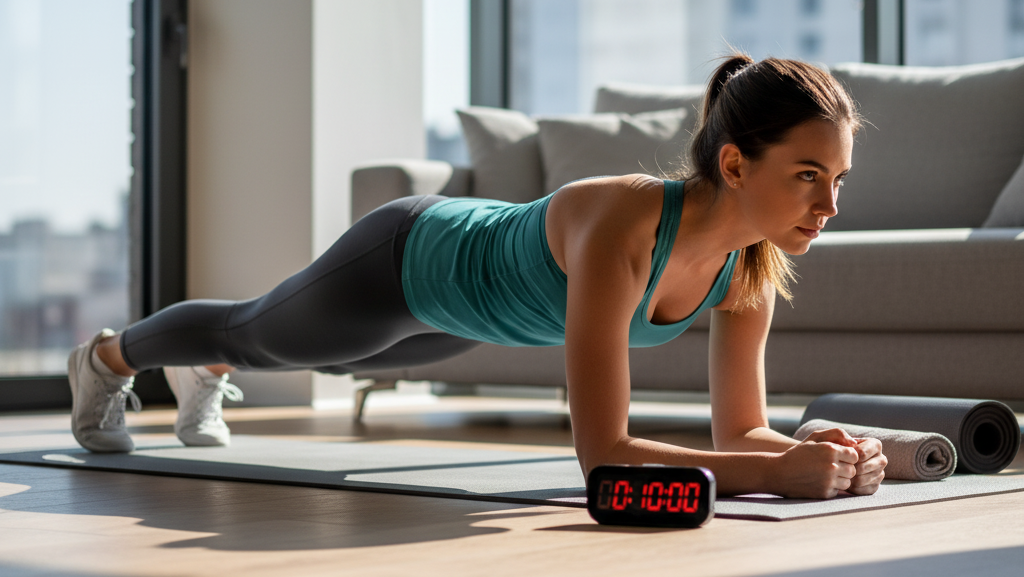
- 1. Plank — elbows under shoulders, neutral spine. (40s)
- 2. Bicycle Crunches — slow and controlled, twist from the core. (40s)
- 3. Reverse Crunches — draw hips upward with core, not momentum. (40s)
- 4. Side Plank (right) — keep hips stacked, breathe. (40s)
- 5. Side Plank (left) — mirror the right side. (40s)
After the first round, rest 30–60 seconds and repeat. Finish with a 30-second child’s pose or gentle spinal twist to cool down.
Progressions and Tool-Based Variations
To keep building strength and avoid plateaus, use progressive overload and gym tools:
- Resistance band: add tension to reverse crunches or plank shoulder taps for extra resistance.
- Stability ball: perform plank with forearms on the ball to increase instability and muscle recruitment.
- Ab wheel: replace reverse crunches with ab wheel rollouts for advanced core challenge.
- Weighted option: hold a light plate or dumbbell on chest for added load during sit-up variations.
Proper Form Tips for Better Results
Form matters more than reps. Poor technique trains the wrong muscles and increases strain. Follow these simple cues every session:
- Neutral spine: avoid overarching or rounding. Think long from crown to tailbone.
- Breathe: exhale on effort (e.g., curl up) and inhale on return. Breath control stabilizes the core.
- Slow down: controlled tempo increases time under tension and encourages muscle growth.
- Quality over quantity: stop if you lose form — fewer perfect reps beat many sloppy ones.
Common Form Fixes
If your hips sag in plank, push through shoulders and tuck the pelvis slightly. If neck strain occurs during crunches, place hands lightly behind head and lead with the chest rather than pulling the neck.
Progressive Overload & Tracking Your Progress
To make steady gains, track your sessions and gradually increase difficulty. Small weekly increases in reps, time, or resistance lead to consistent improvements in strength and muscle growth.
- Increase work time: move from 40/20 to 45/15, then to 50/10 as you improve.
- Add a third round once two rounds feel easy for several weeks.
- Introduce harder variations (ab wheel, weighted sit-ups, uneven planks).
Use tools and calculators to support your fitness routine and recovery. They help you understand calorie needs, macros, and body composition so you can pair your workouts with sensible nutrition.
Read also: “Calorie & Macro Calculator”
Recovery Tips to Support Core Training
Core work is demanding — recovery ensures consistent progress. Recovery isn’t just rest: it’s sleep, hydration, mobility, and strategic deloads.
- Sleep: aim for consistent, quality sleep to support muscle repair and nervous system recovery.
- Hydration: staying hydrated helps muscle function and energy during workouts.
- Mobility: include hip flexor and thoracic spine mobility drills to reduce compensations.
- Deload weeks: every 4–6 weeks, reduce intensity or frequency to let the body recover and adapt.
Small tools speed recovery: foam rollers, lacrosse balls for trigger point work, and a good yoga mat to protect joints during daily practice.
Sample Weekly Plan (Quick)
- Monday: 10-minute ab challenge + 20 minutes strength training (legs or push).
- Tuesday: 10-minute ab challenge + light cardio or mobility work.
- Wednesday: 10-minute ab challenge + upper body strength training.
- Thursday: Active recovery (stretching, foam roll) + optional 10-minute core.
- Friday: 10-minute ab challenge + full-body strength session.
- Weekend: one active rest day and one light core or mobility focus.
Conclusion
This daily 10-minute ab challenge is a practical way to build core strength, improve posture, and support your broader fitness goals. Keep form first, use progressive overload with simple tools when ready, and prioritize recovery. Commit to the routine for several weeks, adjust as you progress, and enjoy stronger movement every day.