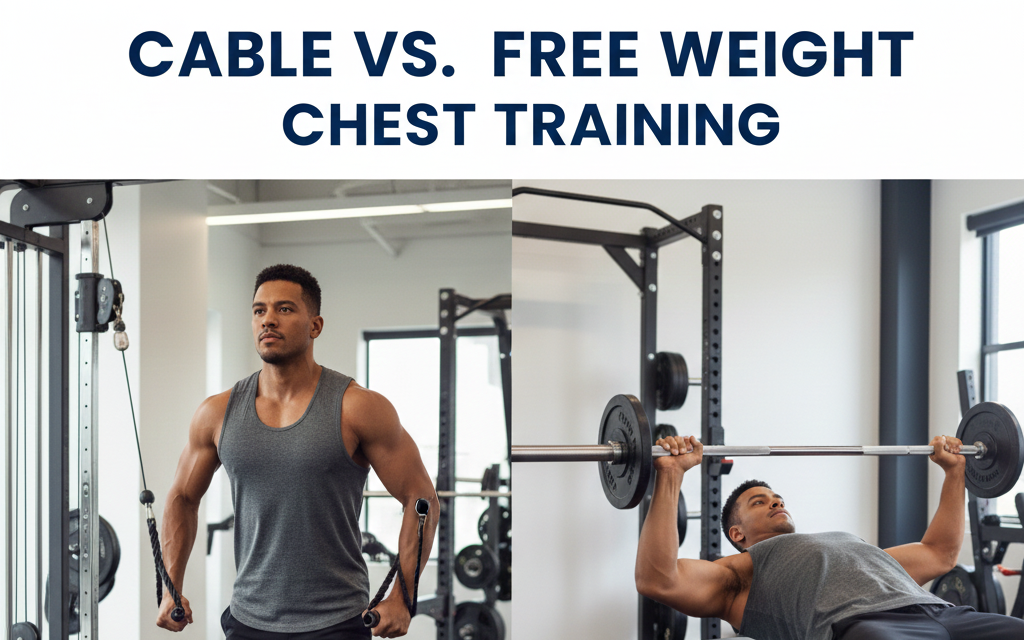
Compare cable vs free weight chest training — learn pros, cons, sample routines, form tips, and recovery advice to build strength and muscle safely.
Deciding between cable and free weight chest training can feel like choosing a favorite tool in a toolbox — both get the job done, but in different ways. Whether you’re chasing size, strength, or a well-rounded chest, understanding the strengths and limits of each option helps you design a smarter workout routine. This guide breaks down practical pros and cons, exercise suggestions, and real-world tips for form, progressive overload, and recovery so you can train confidently and efficiently.
Why it matters: muscle growth, strength training, and workout routines
Both cable and free weight chest exercises contribute to muscle growth and strength training, but they emphasize different mechanics. Free weights tend to tax stabilization and maximal force production, while cables offer constant tension and smoother movement paths. The best athletes and gym-goers use both strategically — alternating tools based on goals, fatigue, and available gym tools.
Key differences at a glance
- Movement path: Free weights follow a natural arc; cables provide constant tension on the muscle throughout the motion.
- Stability demand: Free weights require more stabilizer muscle engagement, especially for heavy barbell pressing. Cables reduce balance demands, letting you focus on the chest contraction.
- Load and progression: Free weights make it easy to add heavy progressive overload. Cables allow fine-tuned resistance and tempo work but may be limited by stack availability.
- Safety and spotting: Cables are often safer for solo lifters, while free weights may need a spotter for heavy sets to avoid injury.
Pros of Free Weight Chest Exercises
Free weights — think barbell bench press and dumbbell press — are staples for a reason. They build raw strength and translate well to functional performance.
- Maximal strength gains: Barbell pressing moves heavy loads for progressive overload.
- Stability and core engagement: Dumbbells increase unilateral control and challenge stabilizers, improving symmetry and joint stability.
- Simple progression: Small, solid jumps in weight make strength tracking straightforward.
- Versatility: Incline, flat, decline, and fly variations cover the entire chest when programmed correctly.
Cons of Free Weight Chest Exercises
Free weights aren’t perfect. They require good biomechanics and can be risky without proper form or a spotter on heavy sets.
- Higher injury risk: Poor technique or ego-lifting increases shoulder and pec injury risk.
- Spotter needed: Heavy bench work is safer with someone to assist.
- Less constant tension: At lockout, tension may shift away from the pecs compared to cables.
Pros of Cable Chest Exercises
Cables are brilliant for sculpting and targeting the pecs with consistent tension and adjustable angles.
- Constant tension: Keeps muscle under load through the entire range of motion for excellent time under tension.
- Angle variation: Easily hit upper, middle, and lower pec fibers by adjusting pulley height.
- Great for isolation: Single-arm cable press and cable flyes enhance mind-muscle connection and correct imbalances.
- Safer solo training: Less risk on max reps; ideal for high-volume finishing work.
Cons of Cable Chest Exercises
Cables do have limitations that affect how you program them for strength and hypertrophy.
- Load limits: Cable stacks can cap how much resistance you can use for heavy strength gains.
- Less stabilization challenge: You may miss out on the full stabilizer engagement that free weights provide.
- Machine-dependent: Requires access to a cable machine and potentially multiple attachments to vary stimulus.
Best chest exercises — cable and free weight options
- Free weight staples: Barbell bench press, Dumbbell bench press, Incline dumbbell press, Dumbbell fly
- Cable staples: Cable fly (high, mid, low), Single-arm cable press, Cable crossover, Standing cable chest press
Programming: When to use each tool
Think of free weights for heavy, compound lifts early in a session and cables for targeted work later. This approach leverages strength for overload and isolation for pump and technique.
- Start workouts with compound free weight presses for 3–5 sets of 3–8 reps (strength focus).
- Follow with incline or flat dumbbell variations for 3–4 sets of 6–12 reps (hypertrophy).
- Finish with cable flyes or single-arm presses for 2–4 sets of 10–15 reps to maximize time under tension and symmetry.
Sample chest workout (balanced)
- Barbell bench press — 4 sets x 4–6 reps (strength)
- Incline dumbbell press — 3 sets x 8–10 reps (hypertrophy)
- Single-arm cable press — 3 sets x 10–12 reps per arm (uni-lateral stability)
- Cable fly (high to low) — 3 sets x 12–15 reps (finisher)
Form, recovery tips, and progressive overload
Good technique and recovery are the backbone of long-term progress. Focus on controlled reps, full range of motion, and deliberate progression.
- Form cues: Retract your shoulder blades, keep a slight arch in the mid-back, and drive through your chest — not just your triceps.
- Tempo control: Use a 2–3 second eccentric and an explosive concentric to maximize tension.
- Progressive overload: Track weights, add reps, or reduce rest times. For cables, increase time under tension or use slower eccentrics when weight is limited.
- Recovery: Prioritize sleep, protein intake, and active mobility. Schedule at least 48 hours between intense chest sessions.
Read also: “Calorie & Macro Calculator”
Coach’s tips: combining tools for better results
Use cables and free weights in the same program to cover all bases. Free weights will drive raw strength and neural adaptation; cables improve symmetry, contraction, and volume management. Rotate emphasis every 4–8 weeks: one mesocycle for strength with barbell focus, the next for hypertrophy with higher volume and cable inclusion.
- Pair heavy presses with lighter, higher-rep cable work to reduce joint stress while increasing muscle stimulus.
- Use unilateral cable presses to fix side-to-side imbalances discovered during dumbbell work.
- Track progress with simple metrics: load lifted, reps performed, and how the chest feels after sessions.
Conclusion
Both cable vs. free weight chest training are valuable. Free weights build foundational strength and stability, while cables deliver constant tension and precision. Use both tools intentionally: press heavy with free weights, sculpt and balance with cables, and prioritize form and recovery. Commit to a plan, track your progress, and mix tools smartly — your chest development will follow.