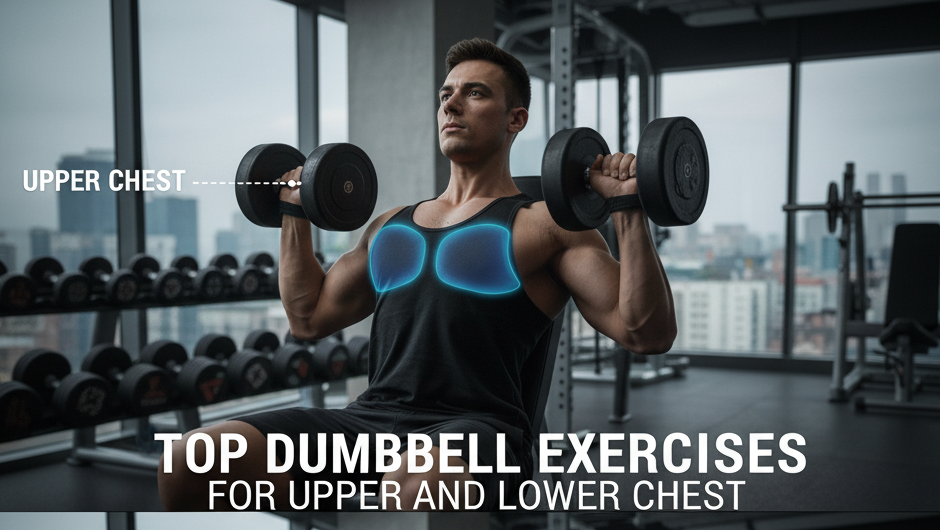
Build balanced chest strength with these top dumbbell exercises for upper and lower chest, form tips, progressive overload, and recovery guidance.
Table of Contents
Dumbbell Exercises for Upper & Lower Chest
Want a fuller, stronger chest without needing a bench full of machines? Dumbbells are one of the most versatile gym tools for targeting both the upper and lower chest. This guide walks you through the top dumbbell exercises, safe form cues, and practical tips for strength training, muscle growth, and recovery so you can build a balanced chest routine that fits any workout plan.
Why Target Upper and Lower Chest Separately
Chest muscles respond to angle and tension. The clavicular head (upper chest) and the sternal head (lower chest) activate differently depending on bench angle and movement pattern.
Using dumbbells lets you control range of motion, fix imbalances, and apply progressive overload with precision — great for consistent muscle growth and improved workout routines.
Top Dumbbell Exercises for Upper Chest
- Incline Dumbbell Press
Setup: Set bench to 30–45 degrees. Press dumbbells up and slightly together.
Form cues: Keep shoulders down, chest up, and drive through your palms. Avoid flaring elbows too wide.
Programming: 3–4 sets of 6–12 reps. Increase weight or add reps each week for progressive overload.
- Incline Dumbbell Fly
Setup: Same bench angle, slight bend in elbows, wide arc to stretch chest.
Form cues: Focus on the squeeze at the top, control the negative. Great for mind-muscle connection and hypertrophy.
Programming: 3 sets of 8–15 reps with moderate weight.
- Single-Arm Incline Press
Setup: One dumbbell at a time to challenge stability and fix side-to-side strength differences.
Form cues: Brace core and avoid rotating the torso. This also engages core and shoulder stabilizers.
Programming: 3 sets of 8–12 reps per side.
- Incline Dumbbell Squeeze Press
Setup: Press two dumbbells together throughout the movement to increase tension on the upper chest.
Form cues: Squeeze dumbbells hard and press in a slightly arced path. Great finisher for muscle growth.
Programming: 2–3 sets of 10–15 reps.
Top Dumbbell Exercises for Lower Chest
- Decline Dumbbell Press
Setup: Decline bench (15–30 degrees), press dumbbells toward hips slightly to emphasize lower fibers.
Form cues: Keep a controlled tempo, drive through the chest and avoid letting the shoulders take over.
Programming: 3–4 sets of 6–12 reps. Use a spotter or controlled weight for safety on declines.
- Decline Dumbbell Fly
Setup: Slight arc, slow eccentric to feel stretch in lower chest. Maintain slight elbow bend.
Form cues: Don’t go too heavy — focus on the squeeze and control to protect the shoulders.
Programming: 3 sets of 8–15 reps for hypertrophy.
- Dumbbell Pullover
Setup: Lie perpendicular on a flat bench or use a slight decline. Pull dumbbell from overhead to chest level.
Form cues: This move stretches the chest and ribcage; keep core braced and move through the shoulder joint carefully.
Programming: 2–3 sets of 10–15 reps as a complementary movement to presses and flies.
- Feet-Elevated Push-Up (with Dumbbell Support)
Setup: Place hands on dumbbells for grip and elevation; feet elevated to shift more load to upper chest or adjust to target lower chest by bench angle.
Form cues: Keep a braced midline and full range of motion for chest activation. Great bodyweight-dumbbell hybrid for strength endurance.
Programming: 3 sets of 8–20 reps depending on load and goals.
Progressive Overload & Workout Routine Tips
Progressive overload fuels consistent strength gains. Track one variable at a time: increase reps, add weight, reduce rest, or improve tempo.
- Start with compound presses (incline/decline) as heavy sets for 6–10 reps.
- Add flies and pullovers for 8–15 reps to emphasize hypertrophy.
- Rotate angles every 4–6 weeks to keep stimulus fresh and avoid plateaus.
Proper Form, Common Mistakes, and Safety
Common errors include using too much weight, flaring elbows, and letting momentum replace muscle tension. Use a controlled tempo and prioritize full range of motion.
If you train alone, use weights you can control for the negative and consider lighter top sets. Dumbbells allow corrective work — embrace unilateral drills to fix imbalances.
Recovery Tips for Better Muscle Growth
Recovery is where the results happen. Include sleep, nutrition, and smart programming to maximize gains without overtraining.
- Allow 48–72 hours between heavy chest sessions depending on volume and intensity.
- Use active recovery and mobility drills to keep shoulders healthy.
- Track protein intake and calories to support muscle repair and strength training goals.
Read also: “Calorie & Macro Calculator”
Conclusion
Dumbbells give you everything needed to build both upper and lower chest strength: control, range of motion, and the ability to load progressively. Pick a few presses and flies, focus on form, use smart progressive overload, and prioritize recovery. Start designing a balanced chest routine today and track progress with the tools above to keep improving week after week.