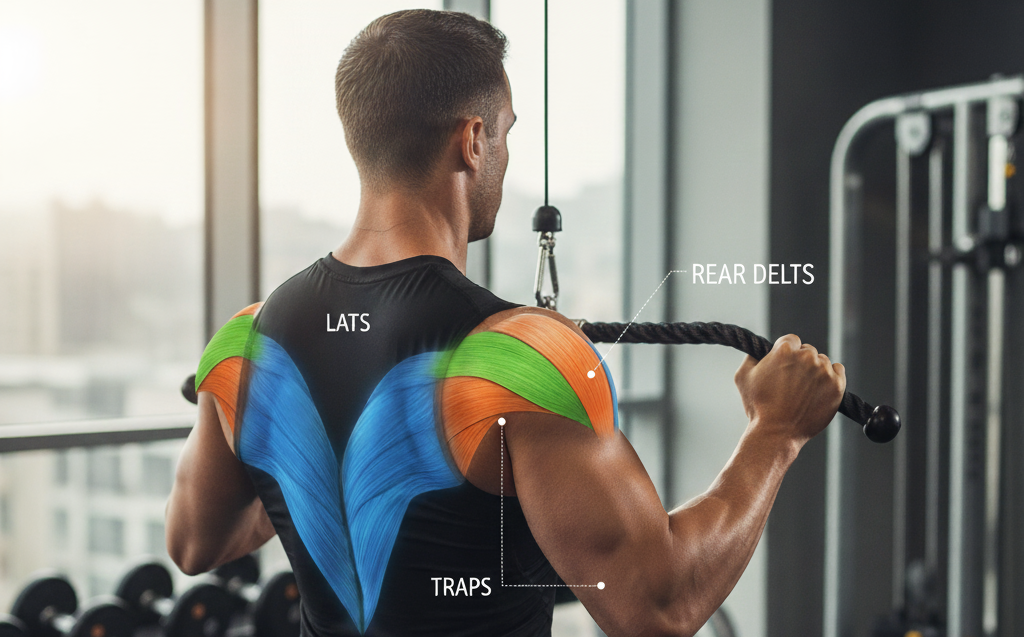
Build a balanced back: combine lats, traps, and rear delts efficiently with form-first workouts, progressive overload, and recovery strategies.
Want a back that’s strong, aesthetic, and functional? A well-designed back day split that targets lats, traps, and rear delts will build width, thickness, and shoulder stability without wasting time. This guide walks you through programming, exercise selection, and recovery so you can train efficiently and progress consistently. Think of this as the coach’s blueprint: clear sets, rep ranges, and tool-based tweaks to sharpen form and force real muscle growth.
Table of Contents
Why Combine Lats, Traps, and Rear Delts?
Combining these three regions on one session makes sense because they work together on most pulling movements. Training them together improves posture, enhances pulling strength, and builds a balanced upper back. That balance reduces compensation patterns and improves other lifts like deadlifts and rows.
Efficient workouts save gym time, promote progressive overload, and let you recover smarter between sessions.
Programming Principles for Back Day
Start with big compound lifts, follow with targeted movements, and finish with isolation to burn out weak areas. Focus on progressive overload—more load, volume, or better technique over weeks.
Key training variables
- Intensity: 70–90% of your max for compound pulls; lighter for isolation.
- Volume: 12–20 sets per session across lats, traps, and rear delts depending on experience.
- Rep ranges: 4–8 for strength, 8–15 for hypertrophy, 15+ for conditioning and blood flow.
- Rest: 60–120 seconds for compounds, 30–60 for isolation.
Sample Back Day Split Workout
This session prioritizes lats first, traps second, and rear delts last—ideal for building size and shoulder health.
- Weighted Pull-Ups — 4 sets x 4–8 reps. Full range, controlled descent.
- Bent-Over Barbell Rows — 4 sets x 6–10 reps. Keep a flat back and pull to the lower ribcage.
- Single-Arm Cable Rows — 3 sets x 8–12 reps each side. Great for lat isolation and correcting imbalances.
- Barbell Shrugs — 3 sets x 8–12 reps. Hold at the top for 1 second to train trap thickness.
- Face Pulls (rope) — 3 sets x 12–15 reps. Cue external rotation to hit rear delts and rotator cuff.
- Reverse Pec Deck or Rear Delt Flyes — 3 sets x 12–15 reps. Slow and deliberate, focus on the squeeze.
Warm-up and Activation
Spend 5–10 minutes on general cardio and mobility. Add band pull-aparts, scapular pull-ups, and light cable rows to prime the lats, traps, and rear delts before heavy sets.
Technique Tips for Maximum Muscle Growth
Technique beats ego. Use controlled tempo and strict form to target the intended muscles and reduce injury risk.
- Pull with the elbows: Cue driving the elbows back instead of pulling with the hands to engage lats more effectively.
- Neutral spine: Maintain a braced core and neutral spine on rows and deadlifts to protect the lower back.
- Full range, controlled negatives: Eccentric control increases time under tension and stimulates muscle growth.
- Mind-muscle connection: Slow down reps on isolation moves to really feel the rear delts and traps working.
Gym Tools That Improve Pulling Power
Using the right gym tools helps you train smarter. Cables, resistance bands, and adjustable dumbbells allow precise tension and variety.
- Cable machine: Constant tension for rows and face pulls—excellent for lat isolation and rear delts.
- Resistance bands: Perfect for warm-ups, progressive overload, and adding variable resistance to rows.
- Adjustable dumbbells: Great for single-arm rows when gym space is limited.
- Lat pulldown attachment and v-bar: Target different lat angles and thicker mid-back activation.
Recovery Tips and Progressive Overload
Muscle growth happens between workouts. Prioritize sleep, nutrition, and targeted recovery approaches to support adaptations.
- Nutrition: Eat enough protein and calories to support muscle repair—use a macro or calorie tool to fine-tune intake.
- Sleep: Aim for consistent sleep to optimize recovery and hormone balance.
- Active recovery: Low-intensity cardio and mobility work on rest days improve circulation and reduce soreness.
- Progressive overload: Track either load, reps, or tempo. If you can perform the top rep range with good form, increase weight next session.
Read also: “Calorie & Macro Calculator”
Using Tools on TotalHealthTools
Before ramping up volume, use tools to plan your diet and recovery. TotalHealthTools’ calculators help set realistic calorie and protein targets so your strength training translates to muscle growth.
Common Mistakes to Avoid
Don’t let small errors stall your progress. Avoid these frequent back-day mistakes:
- Overloading with terrible form—reduce weight and prioritize technique.
- Neglecting rear delts—this leads to rounded shoulders and weak posture.
- Training back every day—insufficient recovery prevents progress.
- Ignoring unilateral work—single-arm rows fix imbalances and build symmetry.
Sample 6-Week Progression Plan
Scale volume or intensity gradually. Example: Weeks 1–2 focus on form (moderate weight, higher reps), Weeks 3–4 increase load (lower reps, heavier), Weeks 5–6 add volume or intensity techniques (drop sets, paused reps).
- Week 1–2: 3 sets per exercise, 10–12 reps, focus on tempo.
- Week 3–4: 4 sets on main lifts, 6–8 reps, increase weight by 5–10%.
- Week 5–6: Maintain weight, add a back-off set or slow eccentrics for extra growth stimulus.
Conclusion
Combining lats, traps, and rear delts into one focused back day delivers strength, symmetry, and better posture when you use smart programming, strict form, and recovery. Track your progress, use tools like TotalHealthTools’ calculators to support nutrition, and keep workouts purposeful—small, consistent improvements add up fast. Get after it and make your next back day count.