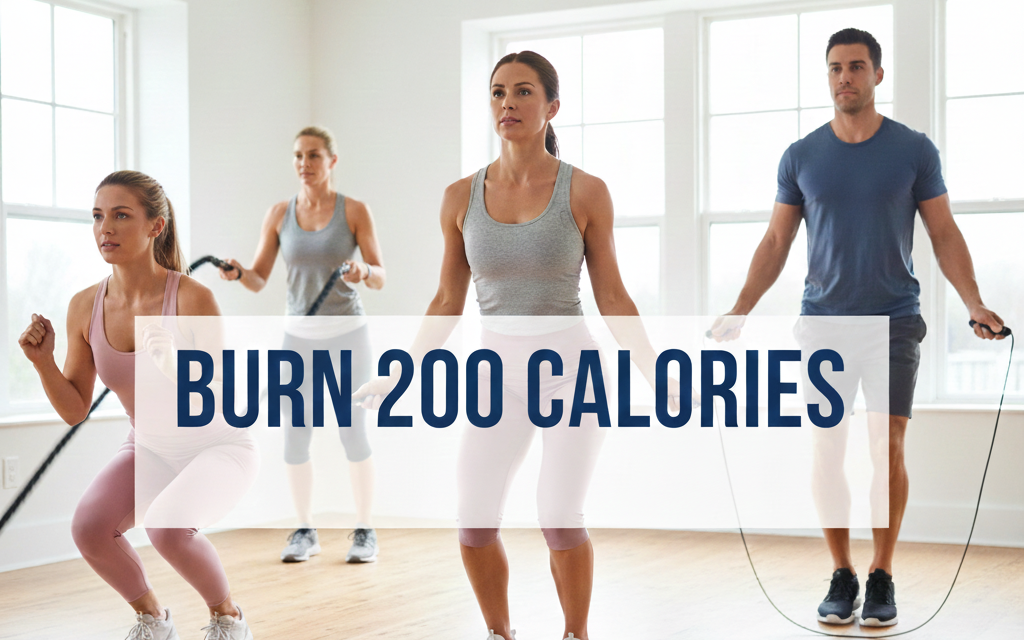
Quick, safe strategies and workouts to burn 200 calories fast — HIIT, strength circuits, sprints, and recovery tips to keep progress steady.
Want a quick energy-burning session that actually fits into a busy day? Burning 200 calories is a practical goal you can hit in 10–30 minutes depending on intensity and the method. Whether you’re pressed for time, training for performance, or trying to tip your daily energy balance, this guide gives fast, safe, and effective ways to torch 200 calories — with real workouts, form cues, progression tips, and recovery strategies you’ll use again and again.
Check also: “Protein Intake Calculator”
Check also: “Workout Calories Comparison”
Why 200 Calories Is a Useful Target
Two hundred calories is small enough to be achievable daily but big enough to support weight loss and fitness goals over time. It can be a standalone mini-workout or part of a longer session. Small consistent wins add up — and psychologically, finishing a short, focused workout builds momentum for the rest of your day.
Calories burned depend on body weight, effort, and the exercise selected. For example, a 160–180 lb person will burn more than a 120 lb person during the same activity. For tech-savvy tracking, consult reliable calorie estimates like those from the American Council on Exercise or Healthline for ranges and safety tips.
High-Intensity Interval Training (HIIT): Fastest Route for Many
HIIT is one of the fastest ways to burn 200 calories because it pushes your heart rate high and keeps your metabolism elevated after the session. Sessions are short and highly effective — perfect for mornings or lunch breaks.
20-Minute HIIT Session to Burn ~200 Calories
- Warm-up 3 minutes: easy jog or brisk march + dynamic leg swings and arm circles.
- Work: 30 seconds sprint or high-intensity move (burpees, jump squats), 30 seconds rest or light jog — repeat 12 rounds (12 minutes work).
- Cool-down 3–5 minutes: walk and stretch hamstrings/quads.
Form tips:
- When sprinting, maintain a slight forward lean from the ankles, not the hips.
- On burpees, soft landings on jumps protect knees; tuck chin on return to plank.
- Keep shoulders relaxed and breathe through nose and mouth to keep intensity sustainable.
Research shows HIIT can produce considerable calorie burn in short periods, but start conservatively and build intensity over weeks. For safety and exercise science resources check ACE’s guidance on interval training.
Cardio Sprints and Hill Repeats
Short, repeated sprints can burn 200 calories quickly — usually in 15–25 minutes if you include recovery between sets. Hills amplify the workload by recruiting more muscle and increasing effort without max-speed on flat ground.
- Warm-up 5 minutes: brisk walk to easy run, dynamic stretches.
- Sprint 20–30 seconds up a hill or on a track; walk back for recovery 60–90 seconds. Repeat 8–10 times.
- Cool-down 5 minutes and stretch calves and glutes.
Progression tip: add one sprint each week or reduce recovery by 10–15 seconds as your conditioning improves.
Rowing and Elliptical: Low-Impact, Big Burn
Rowing engages legs, core, and upper body and can burn 200 calories in about 15–20 minutes at a vigorous pace for many people. The elliptical gives similar numbers with less impact — great for joint-friendly options.
- Rowing workout: 5 minutes warm-up, 12 minutes of 40 seconds hard/20 seconds easy intervals, 3–5 minutes cool-down.
- Elliptical workout: steady-state 20 minutes at moderate-to-hard resistance or interval blocks of 1:1 pace-to-recovery.
Focus on technique: on the rower, drive with the legs first, finish with the arms, then return the sequence smoothly. This optimizes power and protects your lower back.
Jump Rope and Bodyweight Circuits (Great Home Workouts)
Short, explosive equipment like a jump rope turns any living room into a fat-burning zone. Bodyweight circuits combine strength and cardio to increase calorie burn while building fitness.
10–15 Minute Jump Rope Routine
- Warm-up 2 minutes light skipping.
- 5 rounds: 40 seconds moderate jump rope, 20 seconds rest.
- Cool-down and calf stretches.
If you prefer a full body circuit without equipment:
- 30 seconds each: jump squats, push-ups, mountain climbers, walking lunges, plank jacks — rest 60 seconds — repeat 3 rounds.
These home workouts are scalable. If standard push-ups are too hard, use knees or elevated hands; if they’re easy, add tempo or a weighted vest later.
Strength Training Circuits: Burn Fat and Build Muscle
Strength circuits combine weightlifting and short rest periods to maximize calorie burn while stimulating muscle growth. They’re efficient: you get cardiovascular conditioning plus resistance training.
30-Minute Full-Body Strength Circuit (~200 Calories)
- Warm-up: 5 minutes mobility + light cardio.
- Circuit: 3 rounds of 10–12 reps each — goblet squats, bent-over rows, Romanian deadlifts (light), push-ups, kettlebell swings. Rest 60–90 seconds between rounds.
- Cool-down: 5 minutes stretching and breathing.
Strength cue highlights:
- Squats: chest up, knees track toes, sit back onto a chair if needed.
- Rows: hinge at hips, keep spine neutral, pull elbow back rather than lifting with shoulders.
- Swings: hinge from hips, snap through glutes, avoid squatting the movement.
Progressive overload can be applied to strength circuits by increasing load, reps, or reducing rest over weeks — more on that below.
Targeted Short Workouts: Bicep Workouts and Chest Exercises
Focused sessions like bicep or chest workouts don’t burn 200 calories alone as quickly as full-body moves, but when converted into supersets or circuits they can. Supersets combine opposing muscle groups or compound and isolation moves to raise heart rate.
Bicep Workouts — Superset Style
- Alternating dumbbell curls 10–12 reps + hammer curls 10–12 reps back-to-back.
- Superset with 30 seconds of jump rope or mountain climbers to keep heart rate up.
- Repeat for 4–5 supersets.
Form cues for biceps: control the negative (lowering) phase, avoid swinging elbows forward, and keep a full range of motion.
Chest Exercises — Circuit to Boost Burn
- Flat dumbbell press 8–10 reps + push-ups to failure + 30 seconds burpees — rest 60 seconds. Repeat 3–4 rounds.
- Incline push-ups or bench press variations can be used to mix intensity.
Chest cues: retract your shoulder blades slightly before pressing to protect the shoulder joint and keep elbows at ~45 degrees to avoid impingement.
Leg Day Routine: Big Muscles = Big Calorie Burn
Leg workouts engage large muscle groups, producing high calorie expenditure. A focused leg session can burn 200 calories in 20–30 minutes depending on the intensity.
Sample 25-Minute Leg Routine
- Warm-up 5 minutes: walking lunges, bodyweight squats, hip circles.
- EMOM 16 minutes (Each Minute On the Minute): minute 1 — 12 goblet squats; minute 2 — 10 jump lunges; minute 3 — 12 Romanian deadlifts; minute 4 — 20 walking lunges (hold light weight). Repeat 4 cycles.
- Cool-down stretches and foam rolling quads and hamstrings.
Leg training not only burns calories during the session, but increases post-exercise energy expenditure through elevated muscle repair processes.
Gym Workouts: Machines, Free Weights, and Routines
Gyms provide tools that make it easy to hit 200 calories quickly because you can load weights and structure circuits to keep heart rate elevated. Combine compound lifts with short cardio intervals for efficiency.
- Try a barbell complex: deadlift, bent-over row, hang clean, front squat, push press — 6 reps each, 3 rounds with minimal rest.
- Use cardio machines: 10 minutes of rower intervals + 10 minutes of stair climber steady state often reaches ~200 calories.
Gym safety: focus on technique before increasing weight. If uncertain, ask a certified trainer for form feedback or watch professional cues on authoritative sources like the Mayo Clinic for exercise safety principles.
Mayo Clinic exercise guidelines
Recovery Tools and Strategies
Burning calories is only one part of sustainable fitness. Recovery allows you to train consistently and get stronger — which in turn increases your capacity to burn more calories later.
- Sleep: aim for consistent 7–9 hours to support recovery and appetite regulation. Poor sleep reduces performance and can hinder calorie control.
- Hydration: being well-hydrated improves performance and calorie burn during workouts.
- Active recovery: low-intensity walking, mobility drills, and foam rolling the day after a hard session keeps circulation up and soreness down.
- Nutrition: prioritize protein intake to support muscle repair — consider using a protein calculator to dial in your needs.
Check also: “Protein Intake Calculator”
For evidence on recovery and exercise physiology, peer-reviewed resources like PubMed can be helpful when you want deeper reading.
Progressive Overload: The Key to Getting Better and Burning More
Progressive overload is the systematic increase of stress placed on the body to prompt adaptations. When you gradually increase weight, reps, volume, or intensity, your capability rises — and so does your calorie burn potential.
Simple progression plan (8–12 weeks):
- Weeks 1–2: establish form and baseline loads; pick a weight you can control for target reps.
- Weeks 3–6: increase weight by ~5% when you can perform top-end reps for two consecutive sessions.
- Weeks 7–10: manipulate variables — add a set, reduce rest, or include more explosive reps.
- Every 4–6 weeks: take an easier week (deload) to let the body consolidate gains.
Progressive overload applies to cardio too: increase interval intensity, add reps, or reduce recovery as conditioning improves.
Practical Quick Plans to Burn 200 Calories
Here are plug-and-play sessions depending on your time and location. Adjust intensity for your fitness level and bodyweight.
10–12 Minute Power Burst (Advanced)
- Warm-up 2 minutes.
- 8 rounds: 30 seconds all-out (sprint, burpees, or row), 45 seconds active rest. Finish with 2-minute cool-down.
20-Minute Beginner-Friendly Circuit
- 5 minutes light cardio warm-up.
- 3 rounds: 40 seconds work / 20 seconds rest — squats, incline push-ups, bent-over rows (dumbbells), jumping jacks, plank. Rest 60 seconds between rounds.
- Cool-down 3–4 minutes.
At-Home Strength Circuit (20–30 Minutes)
- 3 rounds: 10 kettlebell swings, 12 goblet squats, 10 reverse lunges each leg, 10 push-ups, 30 seconds mountain climbers. Rest 60–90 seconds between rounds.
Use these as templates — track how long it takes you to reach 200 calories with a watch or calorie calculator, then tighten rest intervals or increase load to shave time off future sessions.
Common Mistakes and How to Avoid Them
A few errors can slow progress or cause setbacks. Here’s what to watch for:
- Poor form from chasing calorie numbers — always prioritize safe technique over speed.
- Skipping warm-ups and cool-downs — increases injury risk and reduces performance.
- Overtraining — doing high-intensity sessions every day without recovery will backfire. Schedule hard sessions 2–4 times per week depending on your level.
- Ignoring progressive overload — staying in the same zone produces stagnant results.
When in doubt, reduce intensity and focus on consistency. You’ll build more sustainable fitness that burns calories efficiently over time.
Tracking and Tools
Tracking helps you know what works. Use a heart rate monitor or smart watch for real-time effort feedback. Online calculators and tools can estimate calories burned, but remember they’re estimates.
Useful calculators on Total Health Tools:
- TDEE Calculator — for daily energy needs and to see how a 200-calorie session fits your plan.
- Running Pace & Calories Calculator — helpful if you use running to hit calorie goals.
- Workout Calories Comparison — to compare different activities quickly.
Healthline also provides practical guides on exercise intensity and calorie burn estimates if you want an easy reference for common activities.
How Nutrition Supports Short Calorie Burns
Burning 200 calories is more effective when paired with sensible nutrition. That doesn’t mean extreme restriction. Think of the workout as the stimulus and nutrition as the support system for recovery and adaptation.
- Pre-workout: a small snack with carbohydrate and a touch of protein 30–90 minutes before can fuel high-intensity efforts.
- Post-workout: prioritize protein and carbs within a few hours to assist recovery — especially after strength sessions.
- Daily balance: if your goal is weight loss, aim for a modest calorie deficit spread across meals rather than extreme single-day cuts.
For researching macronutrient splits and meal timing ideas, explore trusted nutrition resources and use internal calculators to personalize protein and energy targets.
Special Considerations: Age, Weight, and Fitness Level
Individuals vary. Older adults or beginners may need longer rests and slower progressions, while experienced athletes can handle higher intensity. Your bodyweight also affects calorie burn — higher body mass usually increases energy expenditure for the same activity.
Make adjustments by scaling exercises, reducing load, increasing rest, and allowing more recovery days. If you have chronic conditions or special concerns, consult a qualified healthcare professional before drastically changing your exercise routine.
Putting It All Together — A 7-Day Mini Plan
This sample week mixes intensity and recovery to show how burning 200 calories fits into a balanced training schedule.
- Day 1: 20-minute HIIT (target 200 calories)
- Day 2: Strength circuit (full body) — moderate intensity
- Day 3: Active recovery — 30-minute brisk walk or mobility work
- Day 4: Hill sprints — 15–20 minutes
- Day 5: Leg day routine (EMOM) — higher volume
- Day 6: Jump rope + bodyweight circuit — 20 minutes
- Day 7: Rest or gentle yoga and foam rolling
Each hard session targets roughly 200 calories for average fitness levels — adjust intensity to match your calorie targets and fitness baseline.
Resources and Further Reading
For science-backed reading on exercise and calorie burn, the NCBI database and trusted health organizations provide strong information. Use ACE and Healthline for practical programming tips and exercise demos.
Conclusion
Burning 200 calories quickly is a realistic, motivating goal that fits into most schedules. Mix HIIT, sprints, strength circuits, and leg-focused sessions to keep training varied and effective. Prioritize form, progressive overload, and recovery so you can do these sessions consistently and safely. Small, consistent efforts build real fitness — start with one focused 200-calorie session this week and celebrate the momentum.