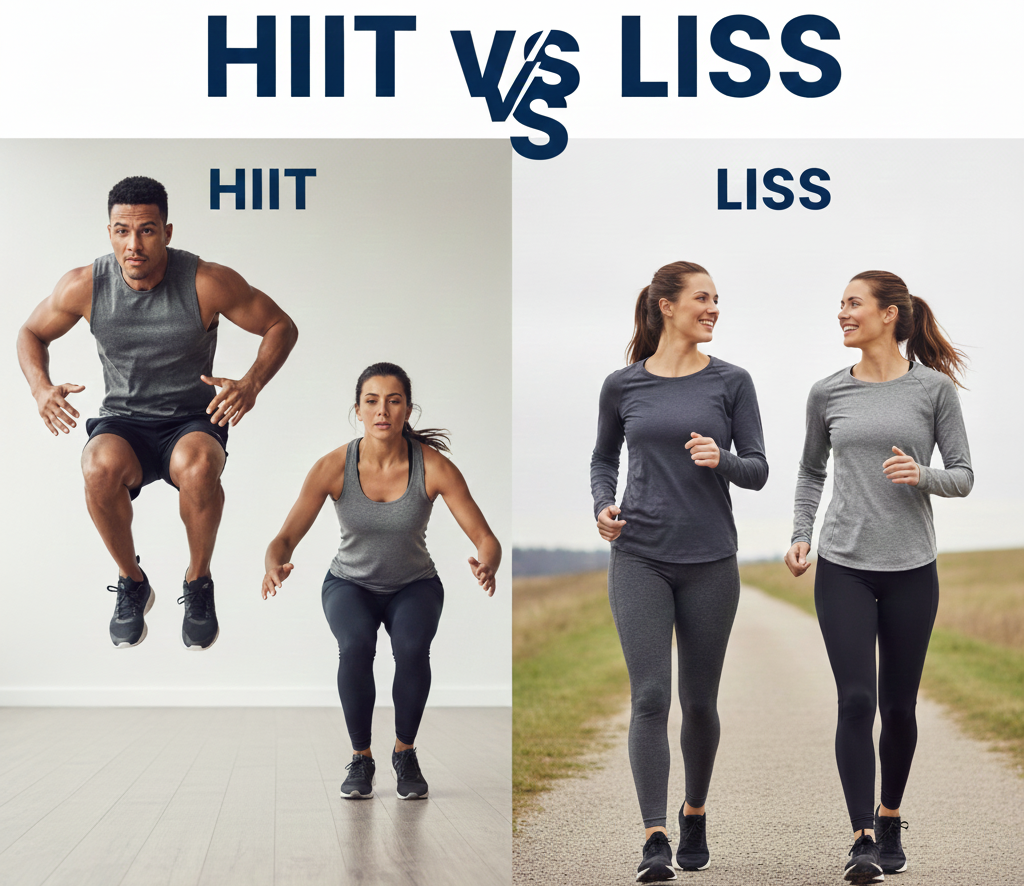
Compare HIIT vs LISS for weight loss, sustainability, and muscle retention. Practical plans, workouts, and recovery tips for real results.
Struggling to decide whether to sprint through a heart-pumping HIIT session or cruise on a steady LISS walk to lose weight? You’re not alone. Both approaches work — but choosing the right one for your body, schedule, and goals makes all the difference. This article breaks down how HIIT and LISS stack up, gives sample workouts, and shows how to combine cardio with strength training for sustainable fat loss and muscle growth.
HIIT vs LISS: A Clear Overview
High-Intensity Interval Training (HIIT) alternates short bursts of near-max effort with recovery. Low-Intensity Steady State (LISS) keeps your heart rate modest and consistent for longer periods. Each has unique benefits depending on calorie burn, recovery needs, and lifestyle.
What is HIIT?
HIIT involves all-out or near-max efforts for short intervals — often 10–60 seconds — followed by rest or low-intensity intervals. Typical sessions last 15–30 minutes. HIIT is time-efficient, increases metabolic stress, and can improve conditioning quickly.
Benefits many people report:
- Higher intensity in less time.
- Improved cardiovascular fitness and anaerobic capacity.
- Potential for greater post-exercise calorie burn (EPOC).
For science-backed context, see guidance from Healthline on HIIT benefits and safety.
What is LISS?
LISS is steady movement like walking, cycling, or easy rowing at a consistent low-to-moderate pace. Sessions are longer — typically 30–60 minutes or more — and are easier to recover from than HIIT.
Common pros:
- Lower injury risk and easier on joints.
- Better for beginners or those returning from breaks.
- Can be used daily to increase calorie burn without heavy fatigue.
Which Burns More Fat: HIIT or LISS?
If your sole metric is calories burned per minute, HIIT usually wins. Short, intense bursts demand energy quickly and elevate metabolism post-workout. But calorie burn alone doesn’t tell the full story for weight loss.
Consider these factors:
- Workout duration and weekly frequency
- Individual fitness level and recovery capacity
- Impact on appetite and adherence to a calorie deficit
Understanding Energy Balance
Weight loss is fundamentally about a consistent calorie deficit over time. HIIT may burn more calories in shorter sessions, but if it leaves you too sore to move or leads to overeating, it won’t help. LISS is lower intensity but easier to do often, helping some people reach higher weekly calorie burns without stress.
Use tools like the TDEE Calculator to estimate your daily needs and plan a sustainable deficit.
Compare workouts by estimated calorie burn here
How to Choose: HIIT vs LISS Practical Decision Guide
Answer these quick questions to pick the right cardio style for you:
- How much time do you have per session?
- Are you new to exercise or returning after an injury?
- Do you want to prioritize muscle retention and strength?
- Which option keeps you consistent and motivated?
If you want a quick roadmap:
- Choose HIIT for time efficiency and conditioning gains if your recovery is good.
- Choose LISS for daily activity, joint-friendly training, and habit building.
- Best long-term: blend both for variety, recovery, and continued progress.
Sample Plans: HIIT vs LISS Workouts for Weight Loss
Here are practical, beginner-friendly sessions you can use and adapt. Keep form first, pace second.
Beginner HIIT (20 minutes)
- Warm-up: 5 minutes brisk walking or dynamic movement.
- Work block (8 rounds): 20 seconds sprint/high-intensity, 40 seconds walk/recover.
- Cool down: 4–5 minutes easy walk and light stretching.
Progression: add rounds, shorten recovery, or increase work time as fitness improves.
Intermediate HIIT (25–30 minutes)
- Warm-up: 5–8 minutes dynamic drills and mobility.
- Work block: 10 rounds of 30s hard / 30s easy OR 40s hard / 80s easy for lower impact.
- Cool down and breathing drills.
Beginner LISS (30–60 minutes)
- Walking at a conversational pace (3–4 mph) for 30–60 minutes.
- Or: easy cycling, elliptical, or swimming for continuous work.
- Aim for 4–6 sessions per week if weight loss is the goal and schedules allow.
Progression Tips for LISS
- Gradually increase duration by 5–10 minutes a week.
- Include slight hills or higher cadence intervals to boost intensity modestly.
- Use heart rate zones as a guide; aim for 50–70% of max heart rate for true LISS.
HIIT vs LISS: Combining Cardio with Strength Training for Weight Loss
Cardio alone can help with caloric burn, but strength training preserves muscle, raises resting metabolic rate, and improves body composition. The best weight loss plans include both.
Progressive Overload in Strength Training
Progressive overload is the principle of gradually increasing stress on muscles to stimulate growth and strength. You can progress by:
- Adding weight (most direct).
- Increasing reps or sets.
- Reducing rest between sets.
- Improving movement quality and range of motion.
Track progress with tools like the One-Rep-Max Calculator to set realistic loading benchmarks.
Weekly Template: Strength + Cardio
Sample 4-day split that balances lifting and cardio:
- Day 1 — Upper body strength (chest-focused) + 10–15 min HIIT finishing blast
- Day 2 — LISS: 45–60 minute walk or bike
- Day 3 — Lower body strength (leg day routine) + mobility
- Day 4 — HIIT shorter session or active recovery
- Day 5 — Push/pull accessory (biceps, back) + optional light LISS
- Days 6–7 — Rest or easy activity (long walk, yoga)
How Much Strength Training?
Aim for 2–4 total-body strength sessions per week when starting. Increase specificity as you progress. Strength training keeps weight loss coming from fat rather than muscle.
Check also: “Protein Intake Calculator”
Designing Workouts: Home Workouts and Gym Workouts
You can get great results at home or in a gym. The choice comes down to equipment, preference, and access.
Home Workouts for Fat Loss
Home workouts can effectively combine HIIT, bodyweight strength, and mobility. Example circuit:
- Bodyweight squats x 12
- Push-ups x 10–12
- Reverse lunges x 10 each side
- Plank 45s
- Burpees or mountain climbers 30s
Perform this circuit 3–5 rounds for a 20–30 minute session. Modify exercises for mobility and fitness level.
Gym Workouts for Fat Loss
Gyms let you use heavier loads and more machines for progressive overload. Pair compound lifts with short cardio intervals for efficiency:
- Barbell back squat 3×6–8
- Bench press 3×6–8 (chest exercises)
- Row variation 3×8–10
- Finish: 10 minutes sled push or bike intervals (HIIT)
Compound lifts maximize muscle engagement, helping preserve lean mass while losing fat.
Targeted Strength: Chest Exercises and Bicep Workouts
Even when prioritizing cardio, targeted strength work shapes your physique and improves performance. Here are practical picks you can do in most settings.
Chest Exercises (Gym & Home)
- Push-up variations — standard, incline, or decline. Cue: keep a neutral spine, shoulders down.
- Bench press — flat or incline. Cue: drive through the chest and keep elbows at ~45 degrees.
- Dumbbell flyes — for feel and stretch. Cue: soft elbow bend, lead with chest, not arms.
- Chest press machine — useful for beginners to control range of motion.
Bicep Workouts (Simple & Effective)
- Standing dumbbell curls — slow eccentric, pause at the top.
- Hammer curls — hits brachialis and forearm stabilizers.
- Chin-ups — compound movement that builds biceps and back. Cue: control the descent.
- Preacher or incline curls — isolates the bicep long head.
Rep ranges for hypertrophy: 8–15 reps for most accessory bicep work. Keep progressive overload in mind: increase weight or reps over time.
Leg Day Routine: Build Strength and Burn Calories
Legs are the body’s largest muscle group and a major calorie burner. A solid leg day supports metabolism and performance.
Solid Leg Day Routine
- Barbell back squat — 4×6–8
- Romanian deadlift — 3×8–10
- Bulgarian split squats — 3×8 each leg
- Leg press or goblet squats — 3×10–12
- Calf raises — 3×12–20
Finish with 10–15 minutes LISS (walk, bike) to aid recovery and increase total energy expenditure.
HIIT vs LISS: Recovery Tools and Habits for Consistent Progress
Recovery is non-negotiable. Without it, intensity backfires and gains stall. Use tools and habits that support frequent training and life.
Practical Recovery Tools
- Sleep tracking and routines — prioritize consistent bedtimes.
- Active recovery — short walks, mobility drills, foam rolling.
- Hydration and nutrition — consistent protein and calorie control.
- Scheduled deload weeks — reduce volume or intensity every 4–8 weeks.
Try the Sleep & Recovery Calculator to plan rest around training load, or the Recovery Time Estimator for session-specific guidance.
Trusted external resources on safe exercise and recovery: ACE Fitness and research summaries on PubMed/NCBI.
How to Progress Without Burning Out
Sustainable progress is about consistency, not maximal weekly output. Follow this plan for long-term wins:
- Start with a baseline test: 2 strength days + 2 cardio sessions weekly.
- Track metrics: weight, measurement, performance, energy, sleep.
- Gradually increase cardio volume or intensity by 5–10% per week.
- Prioritize protein and resistance training to keep muscle mass.
- Schedule rest days and active recovery weekly.
Mistakes People Make with HIIT and LISS
Common errors often reduce results and increase frustration. Avoid these pitfalls:
- Doing too much HIIT too soon — leads to injury or burnout.
- Relying solely on cardio without strength work — muscle loss risk.
- Under-eating after thinking “I’ll burn it off” — leads to low energy and poor recovery.
- Comparing short-term weight changes instead of tracking body composition and performance.
HIIT vs LISS: Nutrition and Protein to Support Fat Loss and Muscle Growth
Nutrition is the backbone of fat loss. Even the best cardio plan can’t out-train a yo-yo diet. Aim for a moderate calorie deficit and adequate protein to preserve muscle.
Protein targets: most people aiming to lose fat while preserving or building muscle should aim for roughly 0.7–1.0 grams per pound of bodyweight per day, depending on activity and goals. Use the Protein Intake Calculator to personalize your target.
Pairing protein with strength training supports muscle growth and recovery, while consistent cardio helps increase the calorie burn needed for fat loss.
Action Plan: 8-Week Roadmap
Implement this simple, progressive plan to test what works for your body while prioritizing health and consistency.
- Week 1–2: Establish baseline. 2 strength sessions (full body), 3 LISS sessions (30–45 min), 1 short HIIT (15 min) optional.
- Week 3–4: Increase strength intensity with progressive overload. Replace one LISS with a longer LISS or an extra HIIT if recovering well.
- Week 5–6: Reassess TDEE and calories. Consider a small deficit of 250–500 kcal/day. Keep protein high.
- Week 7–8: Ramp either HIIT or LISS based on preference. Test body composition and performance (rep PRs, conditioning improvement).
Personalization: Who Should Favor HIIT vs LISS?
Use this quick guide to match personality, goals, and physical condition with the right cardio mix:
- Choose HIIT if you: have limited time, like intense sessions, want fast conditioning improvements, and have good recovery.
- Choose LISS if you: prefer lower impact, need daily movement, are new to training, or are managing joint issues.
- Combine both if you: want variety, are chasing both performance and long-term adherence, and want to protect muscle mass.
Performance Metrics to Track Progress
Beyond the scale, measure the improvements that matter:
- Strength PRs (squat, deadlift, press)
- Endurance improvements (longer LISS distance or faster pace)
- HIIT metrics (more rounds, shorter recovery)
- Body composition or clothing fit
- Energy levels and sleep quality
Real-World Examples
Two realistic scenarios to illustrate choices:
Case A — Busy Professional:
- Limited to 30–40 minutes per day. Prefers quick, intense workouts.
- Plan: 2 HIIT sessions + 2 strength sessions/week. 1 short LISS on weekends.
- Reason: Time-efficient HIIT plus strength keeps muscle while supporting fat loss.
Case B — New to Fitness / Joint-Sensitive:
- Prefers low-impact movement and consistency.
- Plan: 4–6 LISS walks/cycles per week + 2 light strength sessions focusing on form.
- Reason: Sustainable daily activity with controlled strength leads to steady progress.
Final Tips from a Coach
Small, consistent changes beat sporadic intensity. Celebrate incremental wins like improved sleep, better lifts, or more energy. If you love the movement, you’ll keep doing it — and that’s the single best predictor of long-term success.
Conclusion
HIIT and LISS both have a place in effective, sustainable weight loss. Choose the method that fits your schedule, recovery, and preferences — or smartly combine both. Pair cardio with progressive strength training, adequate protein, and prioritized recovery for the best results. Commit to consistency, not extremes, and you’ll see real, lasting change.